
“Spin It Right: How to Identify Clockwise and Counter-Clockwise Propellers for Your Hobby Drone”

Whether you’re building your first quadcopter or replacing old parts, knowing how to identify clockwise (CW) and counter-clockwise (CCW) propellers is essential. Mounting the wrong propeller on the wrong motor can result in unstable flight or even a crash. In this blog post, we’ll break down how to spot the difference between CW and CCW props—with clear images and tips to keep your drone flying smoothly.
🔧 Why Direction Matters
Multirotor drones rely on opposite spinning motors to balance torque. Typically, quadcopters use two CW (also called "right-handed") and two CCW (or "left-handed") propellers. This configuration ensures the drone can hover, yaw, pitch, and roll efficiently. A single misplaced propeller can prevent the drone from even lifting off properly.
🌀 How to Identify Clockwise vs Counter-Clockwise Propellers
1. Blade Angle/Curvature
Propellers are shaped like wings, with an angled surface that determines the direction of airflow.
Clockwise (CW) propellers curve so that when spun clockwise, they push air downward.
Counter-Clockwise (CCW) props curve the opposite way to do the same when spun counter-clockwise.
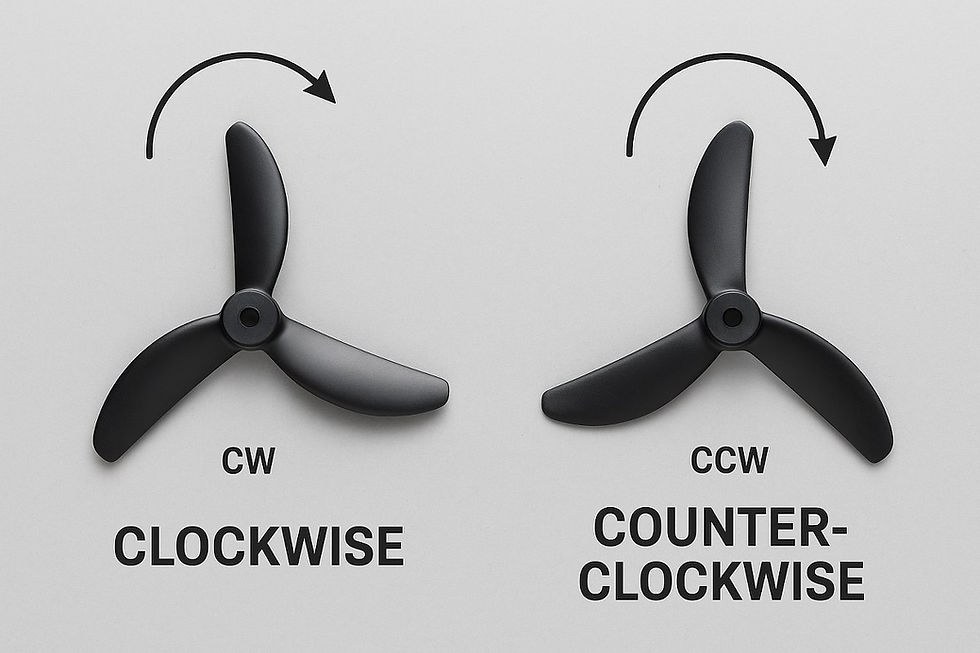
Tip: Hold the prop with the label/text facing you. If the blade leading edge is higher on the right side, it's a CW prop. If it’s higher on the left, it's a CCW prop.
2. Letter Markings
Most manufacturers print “CW” or “CCW” on the hub of the propeller. If not, look for:
“R” = Right-hand rotation = Clockwise
“L” = Left-hand rotation = Counter-Clockwise
3. Propeller Thread Direction (for threaded mounts)
Some props screw directly onto motors. In this case:
CW props usually have normal (right-hand) threads.
CCW props have reverse (left-hand) threads to prevent them from loosening mid-flight.
Tip: If you're unsure, try gently spinning the prop onto a motor shaft. If it tightens while turning in the same direction as the motor spins, it's the correct prop for that side.
✅ Final Tips Before You Fly
Always check your propeller direction before arming the drone.
Match the motor spin direction in your flight controller to the correct prop type.
Use prop guards when testing indoors to avoid injury.
🛠️ Conclusion
Identifying CW and CCW propellers doesn’t require special tools—just a keen eye and a basic understanding of blade design and markings. Master this skill, and you’ll avoid costly mistakes, reduce crashes, and ensure your drone performs at its best.
So next time you're in the workshop or field, remember:
If it spins the wrong way, it won’t fly the right way.


Comments